
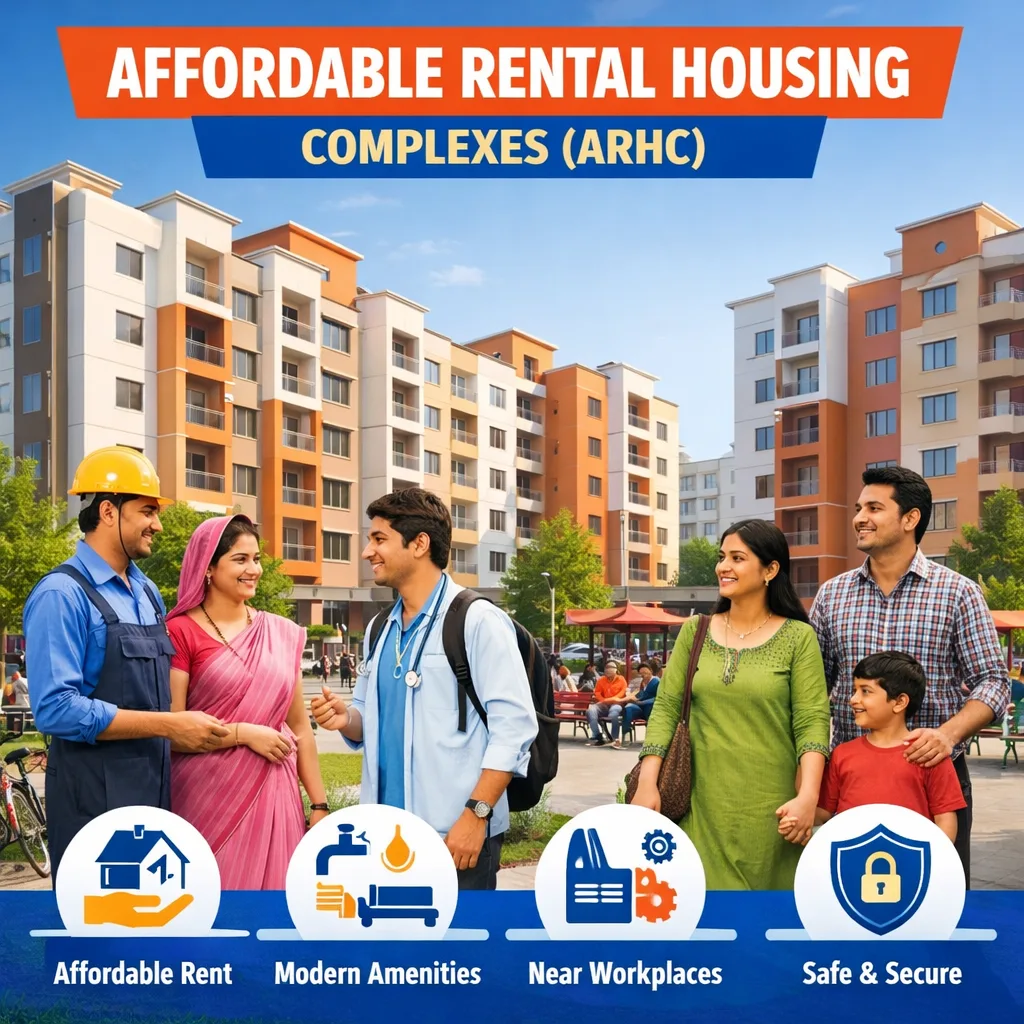
Affordable Rental Housing Complexes (ARHC) is a transformative housing initiative launched by the Government of India to provide dignified, affordable rental housing to urban migrants, low-income groups, and economically weaker sections. Introduced as a sub-scheme under the Pradhan Mantri Awas Yojana – Urban (PMAY-U), ARHC aims to address the growing demand for rental housing in cities while improving the living standards of millions.
What is Affordable Rental Housing Complexes (ARHC)?
Affordable Rental Housing Complexes (ARHC) is a government-backed initiative designed to provide affordable rental homes to urban migrants, industrial workers, students, and economically weaker sections (EWS) in India. The scheme focuses on converting vacant government-funded housing into rental units and encouraging private/public entities to develop new rental housing.
The idea behind ARHC is simple: “Housing for All, even for those who cannot afford to buy.”
Key Objectives of ARHC
The ARHC scheme is built with several important goals:
- Provide affordable and dignified rental housing
- Reduce urban housing shortages
- Support migrant workers and the urban poor
- Promote public-private partnerships (PPP)
- Utilize vacant housing stock effectively
- Improve ease of living in urban areas
Why ARHC is Important in India
India’s rapid urbanization has led to an increase in migrant workers and low-income populations in cities. However, most of them struggle to find affordable housing near their workplace.
Challenges faced by urban migrants:
- High rental costs
- Poor living conditions in slums
- Lack of security and basic amenities
- Long commuting distances
ARHC addresses these issues by offering safe, affordable, and well-equipped rental housing near workplaces.
Key Features of the ARHC Scheme
Here are the major highlights of the ARHC scheme:
1. Affordable Rental Housing
Units are offered at reasonable rent, making them accessible for low-income groups.
2. Two Implementation Models
ARHC operates under two models:
- Model 1: Converting existing vacant government housing into ARHCs
- Model 2: Construction of new rental housing by private/public entities
3. Basic Civic Infrastructure
Each housing complex includes:
- Water supply
- Electricity
- Sanitation
- Roads and drainage
4. Social Infrastructure
Residents benefit from:
- Schools
- Healthcare centers
- Community spaces
5. Proximity to Workplace
ARHCs are usually located near:
- Industrial hubs
- Manufacturing units
- Educational institutions
Target Beneficiaries of ARHC
The scheme is designed for:
- Urban migrants
- Industrial workers
- Street vendors
- Domestic workers
- Students
- Low-income families (LIG/EWS)
These groups often cannot afford to buy houses but need safe and affordable rental accommodation.
ARHC Implementation Models Explained
Model 1: Utilizing Existing Government Housing
- Vacant houses built under previous schemes are converted into rental units
Managed by:
- Concessionaires (private/public entities)
- Operated under a 25-year agreement
Model 2: Construction of New ARHCs
Private builders, industries, and institutions can develop rental housing
Incentives include:
- Tax benefits
- Fast-track approvals
- Higher Floor Area Ratio (FAR)
Benefits of ARHC Scheme
1. For Tenants
- Affordable rent
- Better living conditions
- Security and dignity
- Reduced travel time to work
2. For Developers
- Government incentives
- Long-term rental income
- Reduced project risk
3. For Government
- Efficient use of vacant housing
- Reduced slum population
- Improved urban planning
Rental Structure Under ARHC
Rental pricing is kept affordable and regulated. Key aspects include:
- Rent fixed by local authorities
- Periodic revision allowed
- Affordable for EWS and LIG categories
- Transparent rental agreements
Facilities in ARHC Housing Complexes
Residents can expect modern amenities such as:
- 24/7 water supply
- Electricity connection
- Clean sanitation facilities
- Street lighting
- Community halls
- Parking spaces
- Security systems
Role of Private Sector in ARHC
The ARHC scheme encourages participation from:
- Real estate developers
- Industries
- Manufacturing companies
- Educational institutions
They can build and operate rental housing for:
- Workers
- Employees
- Students
This creates a win-win situation for both businesses and residents.
How to Apply for ARHC Housing?
The application process may vary by state, but generally involves:
- Visit the official state/urban housing portal
- Check available ARHC units
- Submit the application form
- Provide required documents: ID proof & Income proof
- Employment details
- Sign the rental agreement upon approval
Documents Required
Applicants typically need:
- Aadhaar card
- Income certificate
- Employment proof
- Passport-size photos
- Mobile number for verification
Challenges in ARHC Implementation
While ARHC is a promising initiative, it faces some challenges:
- Lack of awareness among beneficiaries
- Limited private sector participation in some areas
- Land availability issues
- Rental management concerns
However, continuous policy improvements are addressing these issues.
Future of ARHC in India
The future of ARHC looks promising due to:
- Increasing urban migration
- Government focus on affordable housing
- Smart city development
- Growing demand for rental housing
ARHC is expected to become a key pillar of India’s urban housing ecosystem.
Frequently Asked Questions (FAQs)
1. What is the ARHC scheme in India?
ARHC is a government initiative that provides affordable rental housing for urban migrants and low-income groups.
2. Who is eligible for ARHC housing?
Urban migrants, EWS, LIG families, workers, and students are eligible.
3. Is ARHC housing free?
No, it is not free. Units are available at affordable rental rates.
4. Can private builders participate in ARHC?
Yes, private and public entities can develop and operate ARHCs under Model 2.
5. How long can tenants stay in ARHC housing?
Tenancy duration depends on the rental agreement, but it is designed for flexibility.
6. Are ARHC homes furnished?
Basic infrastructure is provided; furnishing depends on the developer.
7. Is ARHC available in all cities?
It is being implemented across major urban areas and expanding gradually.
8. What is the main aim of ARHC?
To provide affordable, safe, and dignified rental housing to the urban poor and migrants.
Want to say something? Post a comment
Want to say something? Post a comment
Recent Posts
- Affordable Rental Housing Complexes (ARHC)
- Rajiv Awas Yojana: Urban Housing Scheme Explained Simply
- Pradhan Mantri Awas Yojana Complete Affordable Housing Guide

- Comprehensive Guide to Housing Schemes in India
- AWHO Demand Surveys: Everything You Need to Know

- Armed Forces Housing Scheme in India: A Complete Guide for Homebuyers

- Easy Steps to Book Your Dream Home in Sobha Rivana

- Housing Scheme for Defence Personnel in India

- Land Allotment for Ex-Servicemen in India

- Investing in Property in Rishikesh: A Comprehensive Guide