
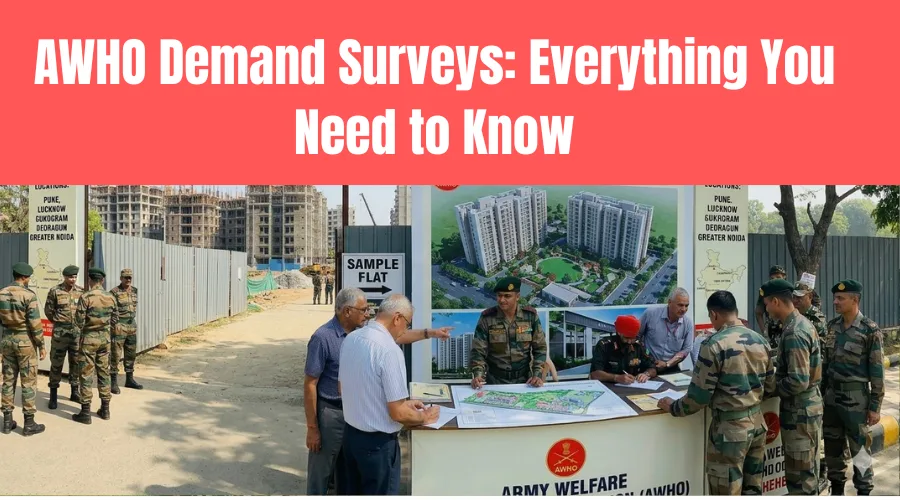
AWHO Demand Surveys: The Army Welfare Housing Organisation (AWHO) serves as the primary gateway for Indian Army personnel to secure quality, affordable housing. For a soldier, a home is more than just a real estate asset; it is a “shanti” (peace) station for their family and a critical anchor for life after retirement.
At the heart of every new AWHO project lies the Demand Survey. Before a single brick is laid or land is acquired, the organization must verify that there is a genuine need for housing in a specific city. Understanding these schemes is essential for any serving or retired member of the armed forces looking to plan their future.
What are AWHO Demand Surveys?
Unlike private developers who may build based on market speculation, AWHO operates on a strictly “No Profit, No Loss” basis. To ensure financial viability, they do not commit resources to a location without guaranteed interest from the fraternity.
A Demand Survey is a formal process used to gauge the requirement for dwelling units (DUs) in a particular station. It serves as a feasibility study to determine:
- The total number of interested applicants.
- The preferred configuration of homes (e.g., 2BHK, 3BHK, or 4BHK).
- The financial appetite for the project at a given estimated price point.
How the Process Evolves
The lifecycle of an AWHO project typically begins with an announcement on the official AWHO website. The process generally follows these stages:
- The Announcement: AWHO identifies a potential city—often based on feedback from Environment/Command HQs—and opens a survey for a set duration (usually 3 to 6 months).
- The Application: Eligible personnel apply by paying a nominal commitment fee. This is not a down payment for a house but a “token of intent.”
- The Threshold Check: For a project to move forward, it must meet a minimum “subscription level.” If a planned project needs 400 units to be viable but only 150 people apply, the survey may be extended or the project shelved.
- Conversion to a “Spot Scheme”: Once the demand is proven, AWHO initiates land acquisition and formalizes the project, at which point the survey is converted into an active housing scheme.
Eligibility and Participation
Participation in these surveys is generally restricted to ensure the benefits reach the intended military community. Primary eligible categories include:
- Serving and Retired Army Personnel: The core demographic.
- Widows of Army Personnel: With specific priority categories for “War Widows.”
- Parents of Deceased Personnel: In cases where the deceased soldier was unmarried.
- Inter-Service Personnel: Depending on the demand, AWHO occasionally opens schemes to the Navy, Air Force, or paramilitary forces if the Army’s internal demand is satisfied.
The Advantage of Early Entry
Many wonder why they should block funds in a survey years before construction begins. The primary benefit is Seniority. AWHO typically follows a “First Come, First Served” or seniority-based system for final allotments. By joining at the survey stage, you often secure a priority number that places you at the front of the line when the project officially launches.
Furthermore, early participants have a silent hand in shaping the project. If the survey results show an overwhelming preference for larger units or specific amenities, the architectural planning will reflect those needs.
Financial Commitment and Security
One of the biggest concerns for applicants is the safety of their funds. AWHO maintains a transparent policy regarding the “Commitment Money” paid during a survey:
- If the Project Proceeds: Your commitment fee is adjusted against the first installment of the house cost once the project is officially launched.
- If the Project is Cancelled: If AWHO cannot secure land or the demand is insufficient, the money is typically refunded with simple interest, ensuring the soldier does not lose the time-value of their money.
- Withdrawal Policy: Most surveys allow for a withdrawal with a minimal administrative deduction, providing flexibility if your personal or financial circumstances change.
Strategic Locations and Trends
Current demand surveys often focus on Tier-2 cities that are emerging as retirement hubs, such as Pune, Lucknow, Dehradun, and Chandigarh (Zirakpur/Panchkula). There is also a significant push toward developing “New Concept” housing, which moves away from traditional high-rises toward independent floors or plotted developments in suburban areas.
For those tracking the latest opportunities, it is vital to keep a close eye on regions like Greater Noida, where infrastructure development and proximity to the national capital make AWHO projects highly sought after for both residence and long-term value.
Important Considerations for Applicants
While AWHO offers unparalleled community living and construction quality, applicants should keep a few strategic points in mind:
- Long-Term Horizon: A demand survey is the very first step. From survey to possession, the timeline can span 5 to 8 years. This is a long-term retirement plan, not a quick move-in option.
- Price Escalation: The costs mentioned in a demand survey are always “estimated.” Final costs may vary based on land compensation issues or the rising cost of construction materials over time.
- Resale Restrictions: To prevent speculation and ensure these homes remain within the “Army family,” there are usually lock-in periods (often 3 to 5 years) before a property can be sold to a civilian.
Who can apply?
- Serving Army personnel
- Retired Army personnel
- Widows of Army personnel
Important Points
- It is not a final booking, just an expression of interest.
- Participation does not guarantee allotment.
- Early participation may give priority benefits in some cases.
Conclusion
The AWHO Demand Survey is a powerful tool that empowers the Indian soldier to secure their family’s future. By participating in these schemes, you aren’t just buying real estate; you are investing in a secure, disciplined, and familiar community.
For the most accurate and up-to-date list of active surveys, always visit the official portal at afwho.org.


Armed Forces Housing Scheme in India Housing Scheme for Defence Personnel in India
Want to say something? Post a comment
Want to say something? Post a comment
Recent Posts
- Rajiv Awas Yojana: Urban Housing Scheme Explained Simply
- Pradhan Mantri Awas Yojana Complete Affordable Housing Guide
- Comprehensive Guide to Housing Schemes in India
- AWHO Demand Surveys: Everything You Need to Know

- Armed Forces Housing Scheme in India: A Complete Guide for Homebuyers
- Easy Steps to Book Your Dream Home in Sobha Rivana

- Housing Scheme for Defence Personnel in India
- Land Allotment for Ex-Servicemen in India

- Cyber Arch Noida Extension

- Investing in Property in Rishikesh: A Comprehensive Guide