
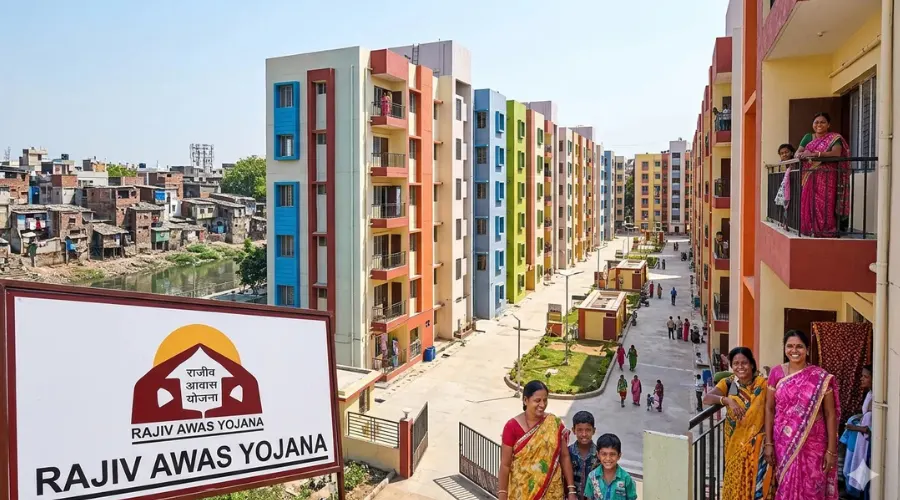
The Rajiv Awas Yojana (RAY) was a flagship housing scheme launched by the Government of India with the vision of creating a “Slum-Free India.” Introduced in 2009 and formally launched in 2011, the scheme aimed to address the challenges of urban slums by providing affordable housing, improving infrastructure, and ensuring a better quality of life for economically weaker sections (EWS) and low-income groups (LIG).
Named after former Prime Minister Rajiv Gandhi, the scheme focused on integrating slum dwellers into the formal urban system by granting them property rights and access to essential services such as water supply, sanitation, roads, and electricity.
Although the scheme was later subsumed under the Pradhan Mantri Awas Yojana (Urban), RAY remains an important milestone in India’s urban housing policy.
What is Rajiv Awas Yojana?
Rajiv Awas Yojana was a centrally sponsored scheme designed to eliminate slums in urban areas by:
- Bringing all existing slums under a formal system
- Providing affordable housing to slum dwellers
- Improving urban infrastructure
- Granting property ownership rights
The scheme emphasized a holistic approach, combining housing construction with urban planning, legal reforms, and social inclusion.
Key Features
- Focus on slum redevelopment and rehabilitation
- Financial assistance from the central government
- Participation of state governments and urban local bodies
- Encouragement of public-private partnerships (PPP)
- Priority to economically weaker sections
Types of Rajiv Awas Yojana
Rajiv Awas Yojana included different approaches depending on the nature and location of slums:
1. In-Situ Slum Redevelopment
This was the most preferred approach under RAY.
- Slums were redeveloped at the same location
- Residents were not displaced
- Basic amenities and permanent housing were provided
Advantages:
- Preserves community networks
- Reduces relocation issues
- Maintains livelihood access
2. Relocation and Rehabilitation
In cases where land was unsuitable (e.g., hazardous areas), relocation was considered.
- Slum dwellers were moved to safer locations
- New housing units were provided
- Infrastructure facilities were ensured
Challenges:
- Disruption of livelihoods
- Resistance from residents
3. Affordable Housing in Partnership (AHP)
This model encouraged collaboration between the government and private developers.
- Private builders constructed affordable housing
- The government provided subsidies and incentives
- Beneficiaries received homes at lower costs
4. Credit-Linked Subsidy Approach
Although limited under RAY, this approach encouraged access to housing finance.
- Beneficiaries could take housing loans
- Subsidies reduced the interest burden
Objectives of Rajiv Awas Yojana
The scheme had multiple social, economic, and urban development objectives:
1. Slum-Free India
The primary goal was to eliminate slums across cities by:
- Upgrading existing slums
- Preventing new slum formation
2. Property Rights for Slum Dwellers
RAY aimed to provide legal ownership or occupancy rights, ensuring:
- Security of tenure
- Protection against eviction
3. Inclusive Urban Development
The scheme promoted integration of slum areas into city planning by:
- Providing equal access to services
- Reducing urban inequality
4. Improvement of Living Conditions
Focus on basic amenities such as:
- Clean drinking water
- Sanitation facilities
- Roads and drainage
- Electricity
5. Strengthening Urban Governance
Encouraged reforms in:
- Urban planning
- Land management
- Municipal governance
6. Encouraging Private Sector Participation
Through PPP models, RAY aimed to:
- Increase housing supply
- Reduce government burden
Selection Criteria for Beneficiaries
The selection of beneficiaries under Rajiv Awas Yojana followed specific guidelines to ensure fairness and transparency.
1. Eligibility Categories
Beneficiaries typically belonged to:
- Economically Weaker Sections (EWS)
- Low Income Groups (LIG)
- Urban poor living in slums
2. Residency Requirement
- Must be a resident of the slum area
- Proof of residence required (ration card, voter ID, etc.)
3. Income Criteria
- Household income within defined limits
- Priority to the poorest families
4. No Existing Property Ownership
Applicants should not own a permanent house elsewhere
5. Women’s Empowerment
- Preference often given to female-headed households
- Property ownership encouraged in women’s names
6. Vulnerable Groups Priority
Special priority was given to:
- Scheduled Castes (SC)
- Scheduled Tribes (ST)
- Minorities
- Disabled individuals
How to Apply for Rajiv Awas Yojana
While the scheme is no longer active, understanding the application process helps in similar schemes like PMAY.
Step 1: Identification of Slums
- Urban Local Bodies (ULBs) conducted surveys
- Slums were officially listed
Step 2: Preparation of Slum-Free City Plan
- Cities created a detailed plan
- Included redevelopment strategies
Step 3: Beneficiary Identification
- Surveys were conducted to identify eligible families
- Documentation collected
Step 4: Submission of Application
Applicants typically needed to submit:
- Identity proof
- Address proof
- Income certificate
- Slum residency proof
Applications were submitted through:
- Municipal offices
- Local authorities
Step 5: Verification Process
- Authorities verified documents
- Field inspections conducted
Step 6: Approval and Allotment
- Eligible beneficiaries were shortlisted
- Houses were allotted
Step 7: Construction and Possession
- Houses were constructed or upgraded
- Beneficiaries received possession
Benefits of Applying for Rajiv Awas Yojana
The scheme provided numerous benefits to urban poor households:
1. Affordable Housing
- Access to low-cost housing
- Financial assistance reduced the burden
2. Improved Quality of Life
- Better living conditions
- Access to basic services
3. Security of Tenure
- Legal ownership or occupancy rights
- Protection from eviction
4. Social Inclusion
- Integration into mainstream society
- Reduced social stigma
5. Economic Opportunities
- Better access to jobs
- Improved productivity
6. Women’s Empowerment
- Ownership rights promoted for women
- Increased financial security
7. Infrastructure Development
- Improved roads, sanitation, and utilities
- Enhanced urban environment
8. Health Benefits
- Better sanitation reduced diseases
- Access to clean water improved hygiene
Challenges Faced by Rajiv Awas Yojana
Despite its noble objectives, RAY faced several challenges:
1. Land Availability Issues
- Difficulty in acquiring land for redevelopment
2. Implementation Delays
- Bureaucratic hurdles slowed progress
3. Funding Constraints
- Limited financial resources
4. Resistance to Relocation
- Beneficiaries hesitant to move
5. Lack of Awareness
- Many eligible people are unaware of the scheme
Transition to Pradhan Mantri Awas Yojana (PMAY)
Rajiv Awas Yojana was eventually merged into Pradhan Mantri Awas Yojana (Urban) in 2015.
PMAY expanded the vision by:
- Targeting “Housing for All” by 2022
- Including broader beneficiary categories
- Offering credit-linked subsidies
Conclusion
Rajiv Awas Yojana was a transformative initiative aimed at addressing one of India’s most pressing urban challenges—slums. By focusing on affordable housing, infrastructure development, and social inclusion, the scheme laid the foundation for future housing programs like PMAY.
Although RAY is no longer active, its principles continue to influence India’s urban housing policies. The scheme demonstrated the importance of a comprehensive approach that combines housing, governance, and community participation to create sustainable urban environments.
For individuals seeking similar benefits today, schemes like PMAY carry forward the mission of providing safe, affordable, and dignified housing for all.
Want to say something? Post a comment
Want to say something? Post a comment
Recent Posts
- Rajiv Awas Yojana: Urban Housing Scheme Explained Simply
- Pradhan Mantri Awas Yojana Complete Affordable Housing Guide
- Comprehensive Guide to Housing Schemes in India
- AWHO Demand Surveys: Everything You Need to Know

- Armed Forces Housing Scheme in India: A Complete Guide for Homebuyers

- Easy Steps to Book Your Dream Home in Sobha Rivana

- Housing Scheme for Defence Personnel in India

- Land Allotment for Ex-Servicemen in India

- Cyber Arch Noida Extension

- Investing in Property in Rishikesh: A Comprehensive Guide